How we verify a grant listing
This page is the published standard behind every GrantWatch listing: what gets checked, in what order, how often, and what is recorded when it is done.
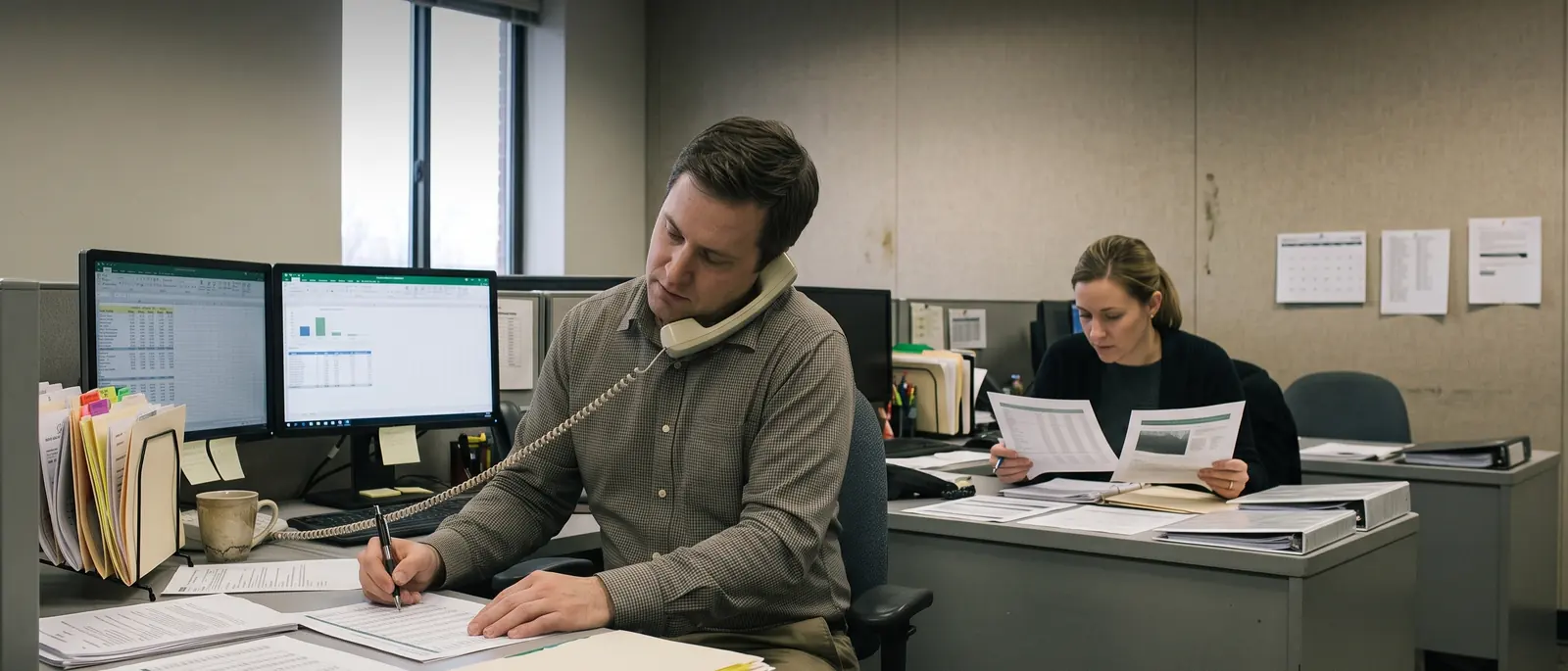
The verification desk. Illustrative photograph.
How often is the database checked?
Our research team verifies and adds new grants to the website five days a week. Daily Database Updates: New grant opportunities are researched, verified, categorized, and added to the platform on a daily basis.
GrantWatch maintains a highly accurate, human-verified grant database that undergoes continuous real-time curation. In practice that means a listing you open on a Tuesday was, in the ordinary case, examined within the current working week rather than at some unrecorded point in the past. Where a listing has not been re-examined within thirty days, it carries a plain notice saying so instead of an implied freshness it has not earned.
What does a research analyst actually check?
A listing passes through five steps before it publishes. The opportunity enters the research queue. It is read against the funder's own posting rather than against a press release or a secondary aggregator. Applicant type, geographic eligibility and the closing date are compared against that source. An analyst signs the record. The listing then publishes carrying the date on which it was checked, so a subscriber can see how current the record is instead of taking it on trust.
Where do the grants come from?
Roughly 70% of our directory comprises of grants from private foundations, public foundations, corporations and charities. The remaining 30% of grants found are from local, state, and federal government funding sources.
That split is the reason the index is not a mirror of Grants.gov. Grants.gov publishes federal opportunities, it is free, and it is the right place to start for a federal application. It does not carry municipal departments, county programmes, community foundations or corporate giving programmes. Those are the majority of what a small applicant is eligible for, and they are what this directory is built to aggregate. Grants.gov is the federal government's own free portal.
Funder research draws on public filings. IRS Form 990 returns are public records under section 6104 of the Internal Revenue Code, which is what makes funder and recipient research possible at all. IRS Form 990 resources.
What is in a verification record?
A verification record is four fields attached to a listing: the primary source, the date and time it was verified, the analyst who signed it, and the check that was performed.
Two of those four are the device. A record renders a verification frame only where both a resolvable, funder-owned primary-source link and a real verification timestamp exist. The other two fields are enrichment: where per-record analyst attribution is not available, the record shows the editorial desk instead, and the frame still stands. Where either floor field is missing, no frame renders at all. The listing carries a plainly worded line saying the verification record is not available and that details should be confirmed with the funder. An honest absence line is worth more than a frame with a dash in it.
Needs client material — Ledger field semantics and coverage position
Two things must come from the client before this page locks: (1) the real field semantics and the real checklist-tag vocabulary, so FIG. GW-02 annotates a record that exists rather than one that was designed; and (2) the share of active records that carry a resolvable funder-owned primary-source URL and a real verification timestamp. At 80 per cent or above the record is the site-wide signature device. Between 40 and 79 per cent it renders only where the floor is met and this page states the coverage position in plain language. Below 40 per cent the multi-tier coverage composition carries the differentiation instead.
What does GrantWatch not do?
GrantWatch is a grant listing directory - we are not the funding source. Therefore, we do not approve applications, award grants, or give money.
Asked directly about the success rate of its users, the company's published answer is this:
We are a grant search engine and listing directory, and therefore, we do not have access to this information. Once a customer clicks on any grant of interest, they are directed to the grant funder's site to complete and submit their application.
That answer is published here rather than buried in an accordion because it is the honest one and because it is checkable. A directory that tracked outcomes would be able to tell you its rate. This one cannot, so it does not claim one, and no page on this site promises an award as a result of subscribing. The Federal Trade Commission requires a reasonable basis for an objective claim before the claim is made, which is exactly the standard being applied here. FTC advertising guidance for business.
Who signs this standard?
Libby Hikind is the Founder and CEO of GrantWatch.com. Holds a post-master's degree in Educational Administration and Supervision.
Libby is often referred to as the 'Queen of Grants.' Libby opened GrantWatch in 2010 after retiring from her 29+ years as a teacher with the New York City Department of Education. For two years, Libby worked as a grant writer for an NYC Dept of Ed Brooklyn school district raising $11 million.
Libby is credited for more than 46,000 children receiving health insurance, as a result of her coalition building of nonprofits and writing the first Staten Island Child Health Plus proposal.
Needs client material — Founder portrait
One title ships site-wide: Founder and CEO, the inventoried title (f062). The derived editorial label used in the earlier footer sign-off was withdrawn in repair pass 1 rather than carried unconfirmed — if the client wants a second, editorial hat named in the methodology sign-off, that is a client-supplied title, not a derived one. The monochrome portrait ships once rights confirmation for the existing photograph lands; it is never generated.
What happens when a listing is wrong?
Corrections go to the editorial desk at editor@grantwatch.com. A funder can also submit or correct its own opportunity directly. Contact the editorial desk.
Needs client material — Correction and changelog policy
A published correction policy, and a per-listing changelog showing when a record was amended and why, are the natural next artifacts for this page. Both need the client's real editorial process before they can be written.
GrantWatch listings are compiled from public records, including IRS Form 990 filings, funder postings and government announcements. GrantWatch does not issue grants and does not make funding determinations. Eligibility rules, award amounts and deadlines are set independently by each funder and are subject to change.
Listings are provided AS IS. GrantWatch does not warrant that any listing is accurate or complete. You are responsible for verifying grant deadlines and eligibility requirements directly with the funder before you apply. Read the full terms.